# Organize Gucci Accessories QC Pics: fashionreps & Sheets  ## What Problem Does This Gucci Accessories QC Organization Solve? When you browse Gucci [accessories](https://fashion-reps.net/accessories) on [fashionreps](https://fashion-reps.net/), the common issue isn't that you can't find products—it's that after saving multiple styles, it's hard
Editor score 4.2 / 5

What Problem Does This Gucci Accessories QC Organization Solve?
When you browse Gucci accessories on fashionreps, the common issue isn't that you can't find products—it's that after saving multiple styles, it's hard to keep track of product images, dimensions, hardware details, variations, and what still needs verification. This guide provides an organization method to help you do the following:
- Find the target Gucci accessories in the product catalog and confirm the style.
- Collect visible QC images and product information in one place.
- Mark areas in images that need further checking.
- Use Google Sheets to filter and compare multiple products.
- Distinguish verified information from pending evidence before placing an order or submitting a purchase.
This guide does not apply to orders where you already have a full physical inspection report, nor does it treat catalog product images as proof of authenticity, material, or final workmanship. Page information and product status may change; this guide is based on visible page content as of October 9, 2026. 🔎
First Confirm Style, Variations, and Visible QC Entry on fashionreps Product Page
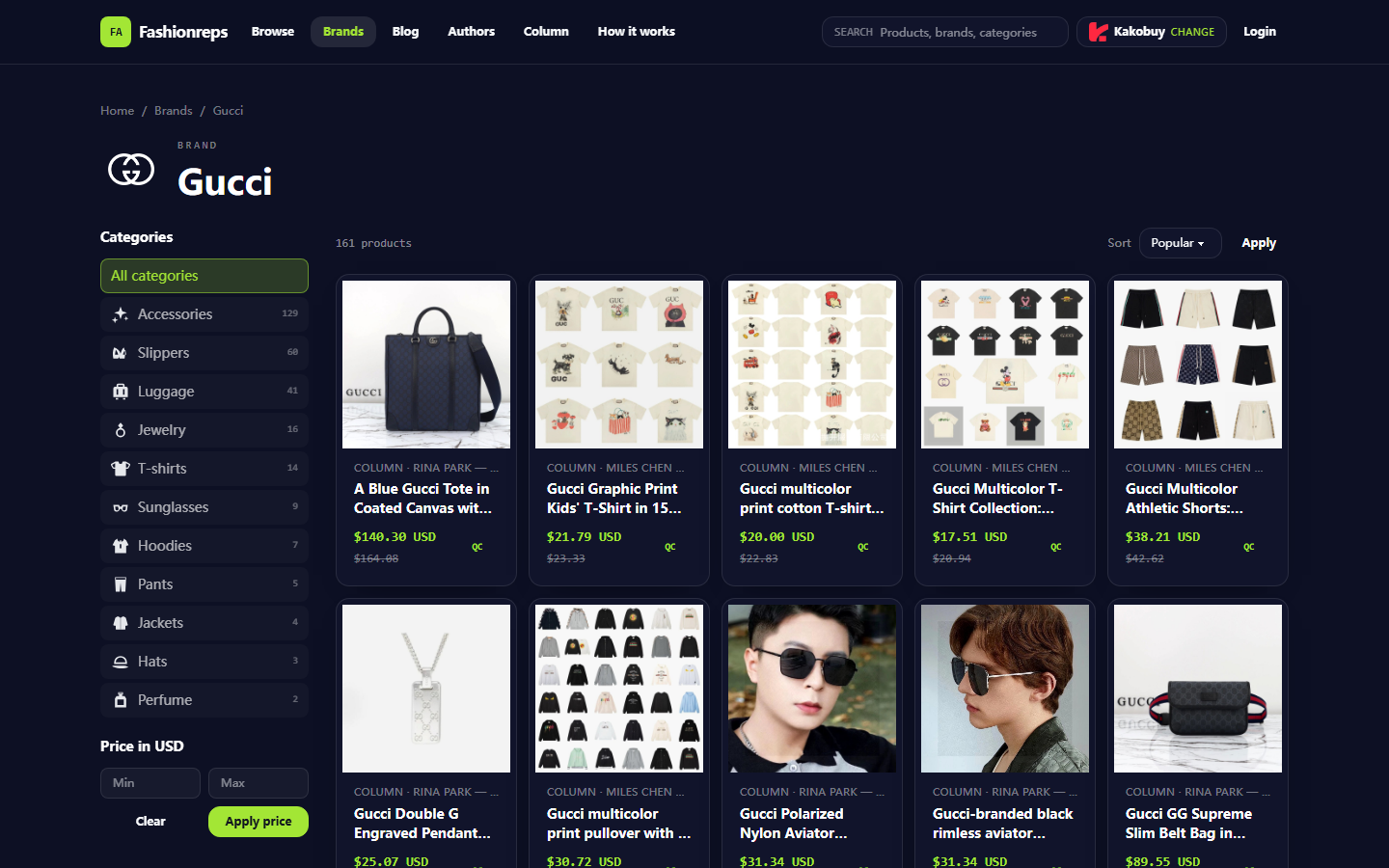
fashionreps' Gucci brand catalog provides brand filter pages, category filters, price ranges, sorting options, and a search entry. Visible Gucci categories include Accessories, Slippers, Luggage, Jewelry, T-shirts, Sunglasses, Hoodies, Pants, Jackets, Hats, and Perfume. The page also shows product counts and reference prices, but this information doesn't replace re-verification of specific product pages before purchase.
When organizing Gucci accessories, start with these confirmations:
- Record the product title; don't just write "Gucci bag" or "Gucci necklace".
- Record the product category, such as bags, belt bags, eyewear, jewelry, or luggage.
- Confirm that the page displays complete size, color, model, or style number.
- Check if the product page has visible images, detailed descriptions, and QC-related entries.
- Record the reference price shown on the page, and note that it's a page reference and not equivalent to final total cost.
- Record the current visible purchase platform selection status to avoid mixing catalog information with agent platform order status.
Sorting options on the catalog page can change your browsing order, such as by popularity, newest, price low-to-high, or price high-to-low. It's suitable for discovery and initial narrowing down, but not for long-term QC archival. Especially when multiple style names are similar, you must keep the product title, images, and dimensions in the same record.
How Website-Based Spreadsheet Centralizes Product Images and Details
fashionreps' website-based catalog is better for discovery and quick browsing. You can first filter by brand, category, and price range, then open candidate products to view visible details. For Gucci accessories, it's recommended to break the catalog browsing into three layers:
Layer one is discovery. Use the Gucci brand page and category filters to first exclude products outside the target category. For example, if you're organizing accessories, don't mix T-shirts or Hoodies into the same QC records.
Layer two is confirmation. Open candidate products and check titles, style numbers, colors, sizes, and page images. If a page only shows blurry images, lacks key dimensions, or doesn't have enough details to support judgment, mark it as "pending evidence" instead of confirming it.
Layer three is archiving. Copy the facts visible on the product page into Google Sheets and keep the original page URL for future reference. Don't only save image file names, because file names usually don't indicate which product or angle the image corresponds to.
The division of labor between website-based catalog and Google Sheets can be understood like this:
| Task | fashionreps website catalog | Google Sheets |
|---|---|---|
| Discover candidate products | Suitable for browsing by brand, category, price, and sorting | Not suitable to replace website search |
| View product images | Suitable for opening original product pages | Suitable for centrally saving image URLs and notes |
| Compare multiple products | Requires switching between pages | Suitable for filtering by size, color, issue status |
| Record items to verify | Depends on reopening pages | Suitable for setting status, assignee, and next steps |
| Collaborative organization | Mainly relies on page sharing | Suitable for multiple people to supplement and check records |
This means Google Sheets is not a replacement for fashionreps, but a worksheet for organizing discovered evidence. 📋
How Google Sheets Records Image Links, Problem Areas, and Pending Evidence Fields
It's recommended to create one row per product and one or more image fields per image. You don't need too many fields, but they must answer three questions: "Which product does this image belong to?", "What do you see?", and "What's missing?".
Possible fields:
- Product title
- Product category
- Style number or model shown on page
- Color or variation
- Page size
- Page reference price
- Product page URL
- QC image URL
- Image angle
- Visible details in image
- Areas to verify
- Current status
- Next action
- Verification date
- Notes
"Visible details in image" should be written as observable descriptions, e.g., "front shows double G logo and strap connection position", not "good workmanship". "Areas to verify" can be written as "need to see inner label", "need to confirm bottom corners", "need to check if dimensions match page values". This reduces the risk of writing subjective judgments as facts.
Recommended limited status values:
- To organize: product found, but fields not yet filled.
- Recorded: page info and image URLs saved.
- Pending evidence: missing key angles, dimensions, or variation info.
- Comparable: main fields for the same batch complete.
- On hold: insufficient evidence, not proceeding at this time.
If collaborating, add "Assignee" and "Last updated date" fields. Don't let different collaborators create duplicate rows for the same product; use product page URL or page-displayed style number for deduplication. ✅
How to Verify the Same Product Under Different Viewing Paths
The same Gucci accessory may be seen multiple times via brand page, category page, search results, and product detail page. When organizing, don't immediately judge as different products just because titles differ slightly, and don't merge records solely based on similar images.
Recommended verification order:
- Compare product page URLs.
- Compare full titles and style numbers.
- Compare colors, sizes, and notable details in page images.
- Compare page reference prices, but don't treat price changes alone as proof of product changes.
- If still uncertain, keep two records and note "pending confirmation if same style".
In Google Sheets, you can add a "Suspected duplicate" column with values "Yes", "No", "Pending confirmation". This is safer than directly deleting seemingly duplicate records and preserves clues for later verification.
When checking images, at least separate the following angles:
- Overall front
- Back or bottom
- Logo or engraving close-up
- Hardware connection points
- Internal structure or inner labels
- Size reference images
If the page only provides some angles, explicitly write "not seen" or "not provided on page", not "none". "Not seen" only means it's not present in the currently visible material, not proof that the detail doesn't actually exist on the product.
How to Separately Record Accessory Details, Hardware, and Size Info
Accessory QC organization shouldn't just record one general evaluation. Different information needs separate fields, otherwise later comparison can easily mix size issues, missing images, and appearance judgments.
For bags or belt bags, you can record body dimensions, strap length, number of zippers, internal compartments, bottom structure, and hardware color. For eyewear, record frame shape, lens color, hinge position, temple logo, and model listed on page. For necklaces or other jewelry accessories, record chain length, pendant appearance, connecting rings, and page-displayed specifications.
For hardware, recommend neutral descriptions, e.g.:
- Gold-tone hardware visible in page images.
- Hardware connection point partially obscured at current angle.
- Logo area needs closer image.
- Images insufficient to judge if there are small scratches on surface.
For dimensions, distinguish three types of information:
- Page-stated size: directly copy visible values from page.
- Buyer-measured: only fill when you actually have measurement records.
- Size to verify: use when page values or images don't support judgment.
Don't automatically treat numbers in product titles as full dimensions, and don't infer actual size from image proportions. If the page only shows a single dimension, note "only single dimension visible". 📏
How Must Visible Images and Editorial Judgments Be Labeled?
The core of QC image organization is separating facts, observations, and judgments:
- Facts: product title, dimensions, color, reference price, and image URL as shown on page.
- Observations: logos, stitching, hardware, or structural positions visible in current images.
- Judgments: decisions to request more images, continue comparing, or pause based on available material.
Judgments should have a basis. For example, "pending evidence because inner label area not shown in current images" is more accurate than "inner label might have issues". The former states the gap; the latter risks writing lack of evidence as a negative conclusion.
Also, don't use expressions like "authentic", "absolutely flawless", "guaranteed consistent", or "passed inspection" that current page material cannot support. The product catalog, images, and reference prices on fashionreps can only support page-level records; final product condition still depends on actual orders, warehouse inspection materials, and applicable after-sales processes.
When saving screenshots or images, keep the source page and retrieval date. If images contain order numbers, addresses, phone numbers, payment info, or other personal data, mask them before sharing, but don't obscure product details that affect QC judgment. 🛡️
Final Action: Complete Gucci Accessories QC Evidence Sheet Before Deciding to Proceed
After organizing, don't jump to conclusions based on a single image. First check that each record has:
- Product page URL for revisiting.
- Image URLs corresponding to the product.
- Clear style, color, or variation information.
- Observed details and details not provided.
- Separately recorded dimensions and hardware info.
- Verification date.
- Clear next action.
If a batch's fields are complete, you can use Google Sheets' filter to view only "Comparable" records and sort by category, size, color, or pending evidence items. If records are still "Pending evidence", the next step is to go back to fashionreps product pages to find missing information, not substitute with similar product images.
This method primarily saves time from repeated page openings, repeated transcribing, and collaborative searching; the added risk is that the spreadsheet may contain outdated prices, dead image URLs, or unconfirmed subjective judgments. Therefore, it's suitable for those who need to compare multiple Gucci accessories, save image evidence, and collaborate on organization; it's not suitable for those who treat the spreadsheet as an authenticity guarantee or final inspection report.
When page information is insufficient, images cannot be revisited, key dimensions are missing, or records cannot be confirmed as the same style, it's not recommended to proceed solely based on the spreadsheet. In such cases, keep the "pending confirmation" status and wait for new page information or compliant warehouse QC materials.
agent platform shopping FAQ
1. What types of products can I find on mulebuyus.com?
mulebuyus.com provides a broad assortment of categories such as footwear, tees, knitwear, hoodies, denim, joggers, shorts, swim shorts, factory clearance deals, puffer jackets, baseball jerseys, button-ups, caps, accessories, bags, gadgets, sunglasses, socks, undergarments, and popular collectibles.
2. What should I do if I'm not happy with the item I received from mulebuyus.com?
You need to contact mulebuyus.com's customer service department immediately. Most non-specialty items from Chinese sellers include a 5-day unconditional return and exchange period. If you're dissatisfied, you can ask for a return. If the item has already been shipped from the warehouse and delivered to you, and you find a defect, you must get in touch with mulebuyus.com's customer service so they can assist you in contacting the seller to arrange a compensation agreement.
Customer service email addresses for various platforms are listed below:
kakobuy: service@kakobuy.com
oopbuy: support01@oopbuy.com
usfans: support@usfans.com
hipobuy: care@hipobuy.com
superbuy: care@superbuy.com
3. Why does mulebuyus.com recommend using a spreadsheet?
Because agent platforms like mulebuyus.com usually do not show products directly, you'll require a spreadsheet to look up the items you want and obtain their purchase links. Another option is to ask for help on Reddit or Discord—the products suggested there are often great, but the buying process can be slow. These spreadsheets are generally built over a long time by collecting data from these communities.
4. Why shouldn't I use Google Sheets for product lists on mulebuyus.com?
Google Sheets works fine only for product lists with very few items. When the product count rises, loading becomes sluggish and the system lags heavily. This is particularly true on mobile devices, where viewing is poor and finding products is very cumbersome. For the same product set, the spreadsheet on mulebuyus.com loads quicker and delivers a better visual experience.
5. What are QC photos on mulebuyus.com?
Every drop-shipping platform, including mulebuyus.com, has a specialized quality control team. When your items reach the platform's warehouse, the platform performs a quality check and takes QC pictures of your goods. Usually three photos are taken, and the team confirms that the color, size, specifications, and quantity match your order. They also look for any quality defects. However, for electronic items, only the external appearance is checked. If there are flaws or the size or color is wrong, the team will promptly request a return from the seller. This guarantees that the products you get are of high quality.