If you've already spotted several [Maison Margiela](https://fashion-reps.net/brand/maison-margiela) shoes on [Fashionreps](https://fashion-reps.net/) but can't yet tell which candidates are worth further verification, the most effective approach isn't to order right away—it's to first build a traceable candidate list. This guide tackles a specific task: finding shoe candidates from a website-style product catalog, then organizing images, sizes, links, prices, and update times into Google Sheets
Editor score 4.2 / 5
If you've already spotted several Maison Margiela shoes on Fashionreps but can't yet tell which candidates are worth further verification, the most effective approach isn't to order right away—it's to first build a traceable candidate list. This guide tackles a specific task: finding shoe candidates from a website-style product catalog, then organizing images, sizes, links, prices, and update times into Google Sheets for pre-purchase review.
This article is for people who need to compare multiple candidates, keep evidence, and collaborate with others. It's not for treating catalog pages as proof of authenticity, treating reference prices as final checkout prices, or estimating total costs without checking destination-country shipping and import rules. Page features and product info may change; the following site observations are as of October 16, 2026, and specific product fields should still be re-confirmed when preparing to buy. 🔎
Defining the Maison Margiela Shoe Catalog Organization Task
First, write the task as an actionable outcome, not just "find Maison Margiela shoes." A good goal: collect several still-accessible shoe candidates, and for each candidate save the product name, product image, size info, current visible price, product page status, QC or image evidence, last verification date, and mark the next step as continue verifying, hold, or exclude.
Once organized, the sheet should answer three questions:
- Does this shoe truly belong to the target category, and not some other item on the brand page?
- What information on the page has been verified, and what's still missing?
- If the candidate moves to the purchase stage, do you need to further confirm sizing, stock, seller info, shipping, taxes, and after-sales conditions?
Fashionreps is better suited for "discovery and initial browsing" tasks, while Google Sheets is better for "filtering, comparing, and collaborating." The two aren't replacements; they're two connected workspaces. 🧭
Verifying the Actual Entry Points and Fields of Fashionreps' Website-Style Spreadsheet
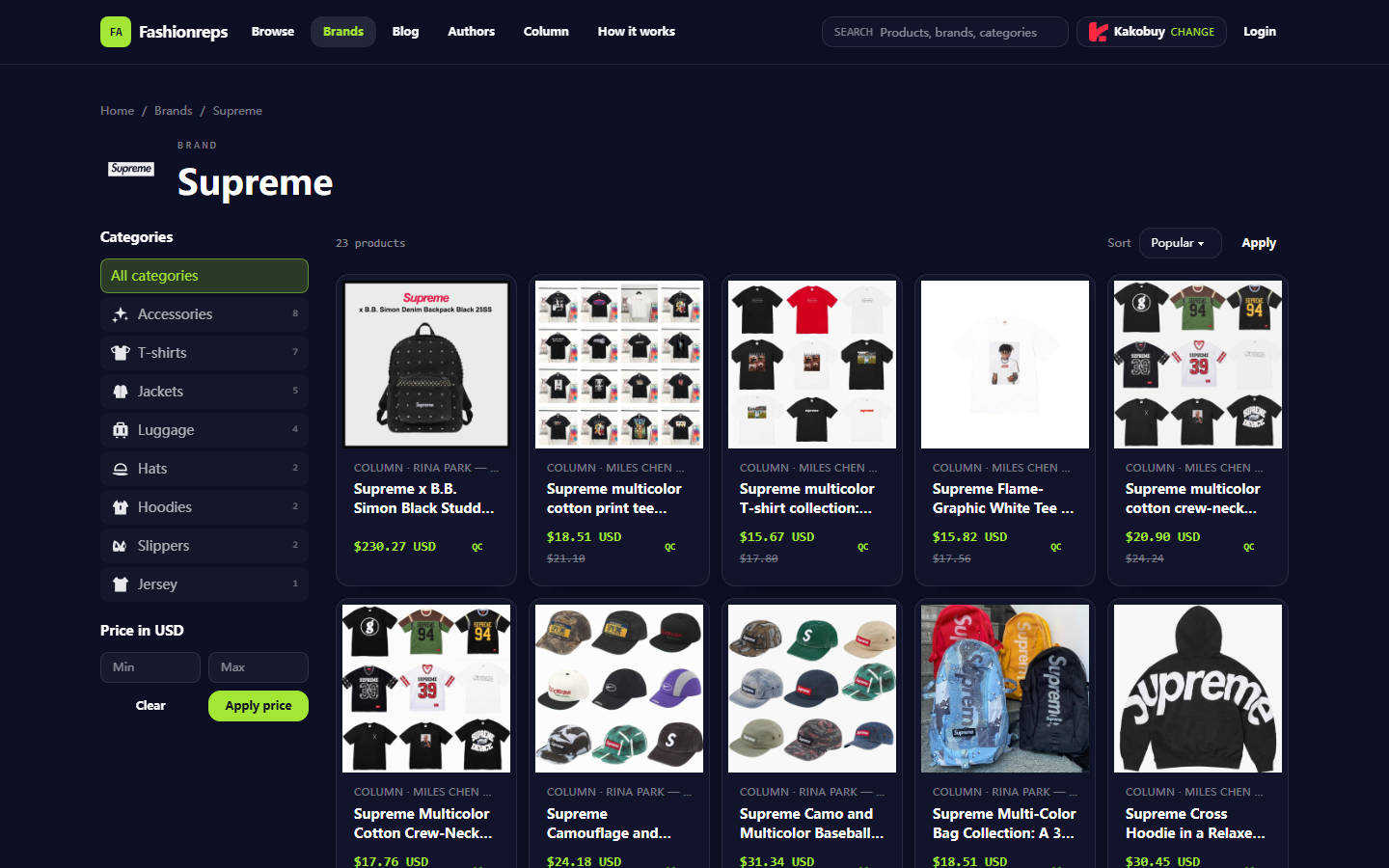
Fashionreps' homepage offers a product search box, product browsing entries, navigation by brand and category, and an image search entry. The page also displays product cards, reference prices, and QC indicators, and lets users select a shopping agent. Note that agent selection affects where the Buy button leads, but it doesn't automatically prove the product's stock, quality, brand authenticity, or final cost.
As of this check, the category navigation shows 304 items in the Shoes category, and the brand navigation shows 11 items for Maison Margiela. These numbers are only the catalog's visible stats at that moment; don't treat them as buyable stock or use them to skip opening each product page.
When opening a candidate page, prioritize recording the fields actually visible on the page. Don't infer material, fit, size range, or seller reliability from the product title; when a field is missing, explicitly writing "not shown" is more useful than filling in guesses.
| Suggested Field | Recording Method | Pre-Purchase Significance |
|---|---|---|
| Candidate ID | Unique ID like MM-SHOE-001 | Avoids mixing up candidates with similar names |
| Page product name | Copy the visible title as-is | Makes it easy to return to the original page for review |
| Category | Shoes, Slippers, or other actual category | Prevents mixing shoes with accessories |
| Brand | Maison Margiela, as shown on the page | Used for catalog classification only, not proof of authenticity |
| Reference price | Keep currency and verification date | Helps spot price changes, can't be the final payment price |
| Image evidence | Save the page's main image or a description of QC photos | Used to compare shape, details, and missing angles |
| Size info | Record sizes shown on page or "not shown" | Determines if extra measurements or inquiries are needed |
| QC status | Yes, No, Unconfirmed | Having a QC label isn't a quality guarantee |
| Product page status | Accessible, redirect, blank, dead | Excludes candidates that can't be re-checked |
| Last verification date | Use YYYY-MM-DD | Identifies outdated facts |
| Next step | Continue verifying, hold, exclude | Makes the list directly useful for decisions |
Discovering Candidates via Categories, Keywords, and Page Navigation
The first round should start from the brand entry, since the goal is already clear. After entering the Maison Margiela brand collection, check each result to see if it's really a shoe. If the brand entry won't open reliably, use on-site search and try natural variants like Maison Margiela, Margiela shoes, Maison Margiela sneakers, Maison Margiela boots, but don't save the same product multiple times just because the search terms differ.
For the second round, cross-check using the Shoes category. Category browsing can uncover candidates missed by the brand entry or with different title phrasing, but it also brings more irrelevant results. At this point, keep only pages that meet these conditions:
- The page loads properly, and isn't blank, a tag-only page, or constantly redirecting.
- The page has a clear product name, and you can tell it's shoe-related.
- At least one piece of visible info for later comparison exists, such as an image, size, price, or product description.
- The page link goes back to the original product, not just back to search results or the brand collection page.
Image search can help spot visually similar candidates, but it can't alone confirm model, material, size, or seller. Image similarity only means they might be visually related, not a substitute for checking the product page. 👟
Setting Up Shoe Verification Columns in Google Sheets
It's best to separate raw records, verification results, and decision fields. That way, when you later update prices or link status, you won't overwrite what you initially saw.
You can create four groups of columns:
The first group is identity columns: Candidate ID, page product name, brand, category, and product page URL. The second group is evidence columns: main image description, QC image status, original size text, original price text, and visible seller info on the page. The third group is verification columns: last verification date, link status, field completeness, and follow-up questions. The fourth group is decision columns: continue, hold, exclude, and exclusion reason.
Use simple status values instead of long free-form text. For example:
Comparable: product page, image, and at least one key field are visible.Size pending: product page exists, but not enough size info.Link recheck needed: page was accessible before, but failed to open this time or redirected.Duplicate candidate: points to the same product or product page as another row.Excluded: not a shoe, blank page, insufficient evidence, or doesn't fit the current task.
In Google Sheets, you can use filters to show only "Comparable" and "Size pending" candidates, then sort by shoe type, size gaps, or most recent verification date. Conditional formatting can highlight rows not rechecked within a certain period in yellow, but don't treat the color itself as a quality judgment. 📊
Comparing Images, Sizes, Links, and Update Times
Image checking should record "what you see," not touch or try-on experiences. For example, note the upper color, sole profile, lacing structure, logo placement, and whether multiple angles are provided; don't write "soft leather," "comfortable," or "runs large" unless the page provides verifiable measurements or clear statements.
For size info, distinguish between size labels, size ranges, and actual foot length advice. If the page only shows EU sizes, don't convert them to US sizes on your own and treat that as a definite conclusion. A safer approach is to keep the original size and add a "Foot length or insole length needs confirmation" column.
Prices also need to be saved with the verification date and currency. Reference prices may not include domestic shipping, agent service fees, international shipping, customs duties, insurance, or other destination-country costs. The final cost should be calculated only after the product, warehouse service, and shipping route are all confirmed.
Check links at least twice: once when adding the candidate to the sheet, and once before preparing to order. If a product page dies, don't delete the original row immediately; keep the dead status and last successful verification date so you don't accidentally re-add the same candidate later.
Comparing the Pros and Cons of Website Card Browsing vs. Spreadsheet Filtering
The advantage of the website-style catalog is discovery speed and context. Product cards usually let you quickly see the image, title, category, and reference price, and brand/category navigation is good for building an initial candidate set. The limitation is that info is scattered across different pages, making it inconvenient to batch-compare size gaps, update times, and exclusion reasons.
The advantage of Google Sheets is putting info from different pages into the same row, making sorting, filtering, deduplication, and collaboration easier. The limitation is that it doesn't automatically ensure data accuracy or automatically update dead links, stock, or prices. The sheet is just an organizing tool; it can't turn missing evidence into verified facts.
So when comparing the two, don't write about which is "faster" or "better" unless you have the same batch of candidates, the same task, and repeatable measurement records. For this task, a more reliable combo is: the website handles discovery, the sheet handles verification, and the original product page handles final review. ✅
Handling Duplicate Candidates, Missing Fields, and Dead Links
Duplicate candidates are common when the same product appears in the brand entry, shoe category, and keyword search. When deduplicating, compare product page URLs first, then product name, main image, and visible price. Don't delete based on similar titles alone, because the same brand may have different colors, different size ranges, or different seller pages.
For missing fields, leave them blank and note the reason. For example, "size not shown," "material not shown," "no QC photos provided," "seller info not visible." This helps you decide whether to keep checking the page, ask the agent, or exclude the item outright.
A dead link doesn't mean the product doesn't exist, nor does it mean the product is still buyable. Change the status to "Link recheck needed" and keep the original URL and date; if it reappears later, use the new page's evidence to decide whether to restore it as a candidate.
For branded products or items with brand logos, catalog info isn't authentication. Don't use unproven conclusions like "authentic," "guaranteed," or "trusted seller," and don't suggest under-declaring, splitting orders to avoid taxes, or evading inspections in order to bypass platform, customs, or destination-country rules. 🛃
Completing Pre-Purchase Review with a Combined Workflow
You can complete a full organization pass in this order:
- Discover candidates in Fashionreps' brand entry, shoe category, and on-site search.
- Create a unique Candidate ID for each valid product page.
- Record the page title, category, reference price, image, size, and QC status.
- Mark missing fields, duplicate candidates, and link status in Google Sheets.
- Use filters to keep only candidates that are still accessible and have enough evidence.
- Before preparing to buy, reopen the product page to confirm price, size, images, and page status.
- Then confirm stock, domestic shipping, warehouse inspection, international route, taxes, restricted-item rules, and after-sales conditions with your chosen shopping agent.
- Only proceed to the ordering decision once all this info aligns with your destination country and budget.
This workflow saves not a fixed amount of money, but reduces repeated searches, repeated saves, and wrong decisions caused by dead links. It also adds some organizing time, especially when you need to open pages one by one, record verification dates, and clean up duplicates.
The people who benefit most are those comparing multiple shoes at once, needing to keep image and link evidence, or needing to review together with friends. If you only want to quickly browse one or two candidates, using the website pages directly may be easier. It's not recommended to build an overly complex sheet when there are very few candidates, page fields are already complete, or you don't have time to re-verify before ordering.
Ultimately, treat Google Sheets as a pre-purchase checklist, not a substitute for proof of quality or authenticity. The website catalog helps you discover candidates, the original product page helps you confirm facts, and the shopping agent plus destination-country rules decide whether it's ultimately suitable to order.