This article addresses a specific problem: when the Jordan shoe QC photos provided on a fashion-reps product page lack key viewing angles, how to determine whether the image coverage is insufficient, the specification information is inconsistent, or the situation is already sufficient to trigger a pause. After reading, you should be able to do three things: confirm that the product model, color, and size correspond; list the angles that need to be reshot and the verification questions; and pause
Editor score 4.2 / 5
This article addresses a specific problem: when the Jordan shoe QC photos provided on a fashion-reps product page lack key viewing angles, how to determine whether the image coverage is insufficient, the specification information is inconsistent, or the situation is already sufficient to trigger a pause.
After reading, you should be able to do three things: confirm that the product model, color, and size correspond; list the angles that need to be reshot and the verification questions; and pause the purchase or consolidation when evidence is insufficient. This article only discusses the verification of product pages and QC photos, and does not prove the authenticity, comfort, durability, or authenticity of a specific pair of shoes.
What QC troubleshooting task does this solve for jordan shoes
The goal is not to make a purchase decision based on a single "looks good" photo, but to determine whether the current photos can support the next action. For Jordan 11-style shoes, at least the upper, toe, sole, heel, and left-right foot correspondence should be checked separately.
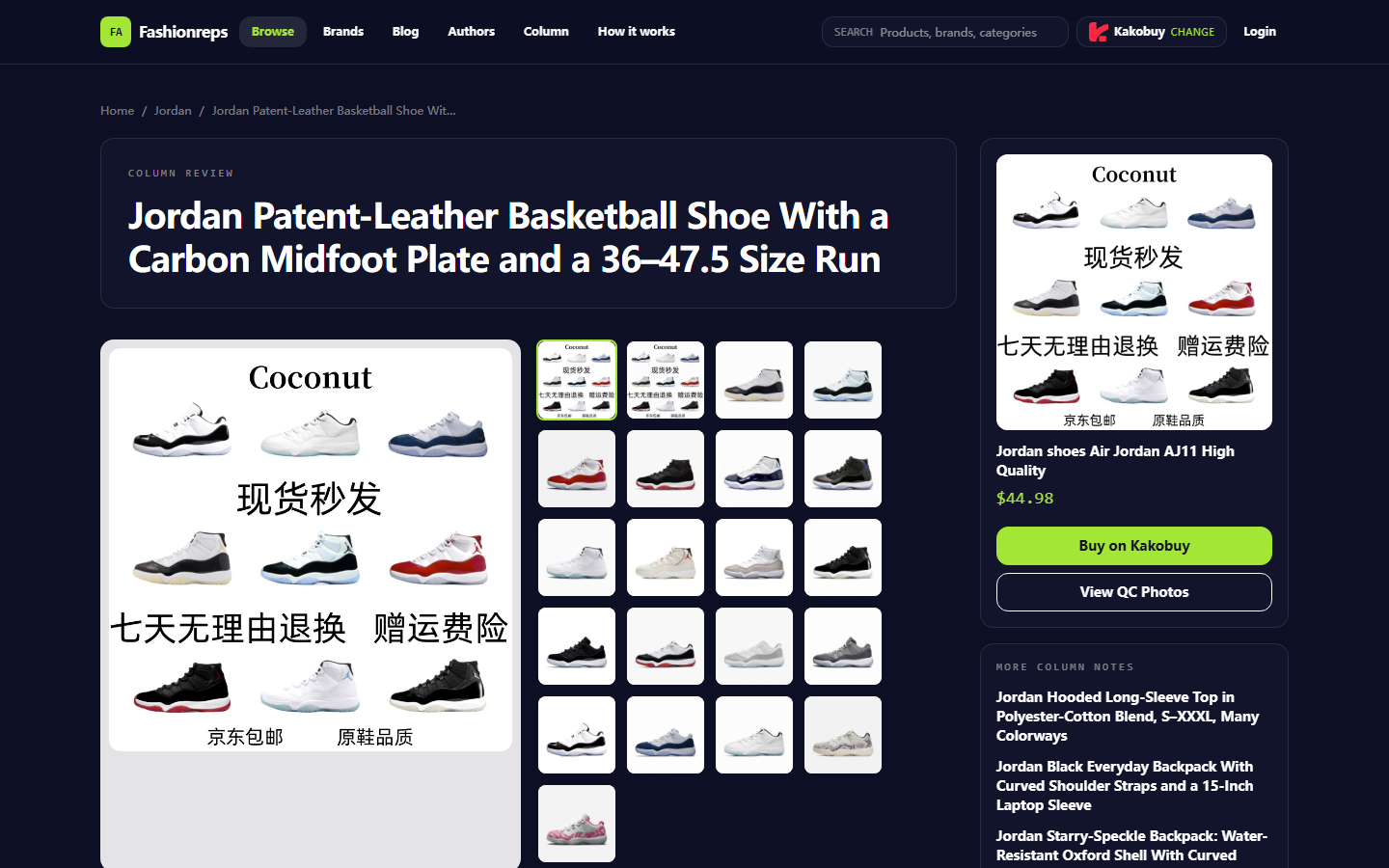
As of October 11, 2026, the referenced fashion-reps product page describes this model as a Jordan 11-style shoe and lists a patent leather upper, full-length Air Sole, carbon fiber midfoot plate, translucent outsole, and a size range of 36–47.5. The page also explicitly states that these are catalog information and do not constitute independent QC proof for the specific pair received. 🧾
First confirm model, color, and size from the fashionreps product page
Do not open the QC photos and directly judge defects. Go back to the product page and record the following information:
- The model or style description in the product title
- The colorway, upper color, and outsole color displayed on the page
- The selected size, and whether there are any size gaps on the page
- The materials, structure, and accessories claimed in the catalog
- The current reference price, verification date, and currency
- Whether the QC photos clearly indicate the product, size, or order they belong to
If the title only says Jordan or AJ11 style without clearly describing the colorway, color differences in the photos cannot be directly judged as a wrong model. Conversely, if the product page states a translucent outsole but the QC photos show an opaque outsole, you should pause and ask the seller to confirm, rather than treating it as a normal lighting difference.
Enter the corresponding QC photos and list the missing viewing angles
It is recommended to classify existing photos according to "whether they can support judgment" rather than by photo count. Common gaps include:
- Only top-down views, no front view of the toe or front-side angle
- Only the left shoe, no right shoe, making it impossible to compare symmetry
- Only the upper photographed, no outsole or heel
- Photos too far away to see the patent leather edge, stitching, or glue lines clearly
- The sole is covered by packaging or shadows, preventing inspection of the tread and stains
- No size tag, shoe box label, or pairing information
- Both shoes mixed in one image, making it impossible to confirm whether the left and right feet belong to the same pair
"Having photos" does not equal "having evidence." If key areas are cropped, severely reflective, or low resolution, they should be recorded as missing angles rather than filled in from experience. 📷
What visible evidence is needed for the upper, toe, sole, and heel separately
For the upper, focus on whether the patent leather edges have obvious wrinkles, pressure marks, glue overflow, or uneven color. Slight reflections and highlights from photography alone cannot prove patent leather damage, so you need the seller to provide more stable oblique lighting or close-up photos.
For the toe, you need front and left-right front angles to observe whether the shape of the two shoes is roughly symmetrical, whether there is obvious collapse of the toe, and whether the lace holes, tongue, and forefoot seams correspond. Do not judge toe proportions from a single top-down photo.
For the sole, you need a full sole photo and close-ups of the forefoot and heel, focusing on outsole color, tread pattern, obvious stains, and edge bonding. The product page mentions that translucent outsoles may yellow over time, but this is a general risk warning for this type of shoe, not a QC conclusion for the current pair.
For the heel, you need left and right rear photos to observe heel height, stitching direction, logo position, and obvious deformation. If only one side of the heel is visible, you cannot confirm whether the other side has the same problem.
If the shoe structure or carbon fiber midfoot plate matters for your purchase decision, catalog text is not sufficient to prove internal structure. Unless the seller provides verifiable close-up photos or descriptions that do not damage the product, it should only be treated as catalog information pending confirmation.
How to distinguish missing photos from product specification inconsistencies
You can judge in the following order:
- First check whether the product page, order options, and QC photos point to the same model.
- Then verify whether the color, size, left/right shoes, and shoe box label correspond to each other.
- Finally determine whether the photos are clear enough to support the issue you want to check.
Missing photos mean "not yet able to judge," for example, there is no sole photo, so you cannot confirm whether there are obvious stains on the outsole. Specification inconsistency means "existing information conflicts," for example, the ordered color is clearly different from the shoe box label or upper color. The former is usually suitable for requesting reshot photos, while the latter should pause first and ask the seller to explain.
Do not write common Jordan 11 buyer feedback, such as pressure marks, glue marks, or thin patent leather, directly as problems that have already occurred in the current order. The reference page does not record independent QC results for this specific item, and any current defects need to be supported by corresponding photos or seller responses.
Reshoot requests should specify location, direction, and verification questions
Reshoot requests should avoid only writing "please take clearer photos." You can propose by location and purpose:
- Please reshot the front and left-right front sides of the toe of both shoes to confirm the shape and symmetry.
- Please reshot the entire outsole of both shoes and close-ups of the forefoot and heel to confirm color, tread pattern, and obvious stains.
- Please reshot the left and right heels to confirm logo position, stitching, and heel deformation.
- Please take photos of the tongue size tag, shoe box label, and the correspondence of both shoes in the same frame.
- Please take close-up photos of the suspicious points found, and indicate whether it is the left or right foot, and the inner or outer side.
If the seller cannot reshot a certain angle, they should clearly state the reason. No response, responses inconsistent with photos, or repeating catalog text cannot replace missing visual evidence. 💬
What judgments cannot be proven by QC photos
QC photos can help identify visible appearance issues but cannot alone prove the following:
- Actual internal materials, structure, or long-term durability
- Comfort, that the size will surely fit, or that wide feet always require sizing up
- The future discoloration rate of the translucent outsole
- Whether the product is authentic or has brand authorization
- Logistics, taxes, after-sales results, or successful returns/exchanges
- Unseen separation, odor, hardness, and actual weight
The $44.98 listed on the reference page is only a reference price for the product, and service fees, international shipping, and other charges need to be confirmed on the selected purchasing agent platform. Do not treat catalog prices or photo judgments as final payment terms. 💰
Final action: choose reshot, inquire, or pause based on evidence completeness
When evidence is relatively complete, you can continue to verify size, fees, destination country restrictions, and after-sales conditions; but you should still keep page information and reshot records.
When only one non-core angle is missing, you can request a reshot first and then decide whether to continue. If key evidence such as toe, outsole, heel, or left-right comparison is missing, you should pause the purchase or consolidation until you obtain photos that can be judged.
It is not recommended to continue operating in the following situations:
- Product color, size, model, or shoe box labels conflict with each other
- The seller refuses to provide key angles, or responses cannot correspond to the photos
- Key areas remain blurry, obstructed, or suspected of being cropped
- You must rely on "it should be fine" to complete payment
- The matters you require confirmation involve internal quality, authenticity, or long-term performance that cannot be proven by photos
Official help channels should prioritize the product page's purchasing agent entry, the order customer service of the selected agent, and seller message records. When submitting questions, provide only necessary order information and do not publicly share complete waybills, payment cards, passports, or other irrelevant personal data.
The final decision can be simple: if evidence is sufficient, continue to verify fees and receipt conditions; if insufficient, request reshot; if there is conflict or the other party cannot explain, pause. This will not eliminate the quality risks of the shoe itself, but it can prevent misjudging missing photos as qualified QC.
Article image

agent platform shopping FAQ
1. What exactly are QC photos on litbuy-ai.com?
litbuy-ai.com has a professional quality inspection team. When your goods arrive at the platform warehouse, the team will conduct quality inspections and take QC photos. Usually three photos are taken, and they also check whether the product color, size, specifications, and quantity match the order, and check for quality issues. Except for electronic products, which only check appearance. If quality issues or size/color mismatches are found, the team will immediately apply for a return to the seller to ensure you receive good quality products.
2. Why does litbuy-ai.com need to use spreadsheets?
litbuy-ai.com usually does not display products directly, so you need to use spreadsheets to find desired products and their purchase links. You can also seek help on Reddit or Discord; products recommended on these platforms are usually good, but the purchase process is slower. These spreadsheets are generally compiled from long-term information collected from the above platforms.
3. How to view quality inspection photos on litbuy-ai.com?
When viewing quality inspection photos, you should focus on the specific characteristics of the purchased product. For example, for shoes, check key parts such as the toe, heel, and tongue, and observe stitching, shoe shape structure, and tongue thickness to judge whether it is a high-quality shoe. For clothing, check details such as collar labels, logo embroidery, fabric, and the flatness of the collar and cuffs.
4. What types of products are in litbuy-ai.com spreadsheets?
litbuy-ai.com spreadsheets cover footwear, clothing, bags, accessories, jerseys, perfumes, hats, scarves, belts, and various household daily necessities.
5. Why not use Google Sheets on litbuy-ai.com?
Google Sheets is only suitable for spreadsheets with a small number of products. Once the number of products increases, loading becomes very slow and the system lags noticeably. Especially on mobile devices, the visual experience is poor and searching for products is extremely inconvenient. For the same product collection, litbuy-ai.com's spreadsheets load faster and have a better visual experience.