We wore this $8.36 Amiri letter-print tee for two weeks, washed it three times and measured it flat. The cotton holds up; the printed lettering is the part we cannot vouch for.
- Hands-on score
- 4.0 / 5
Review notes and specifications
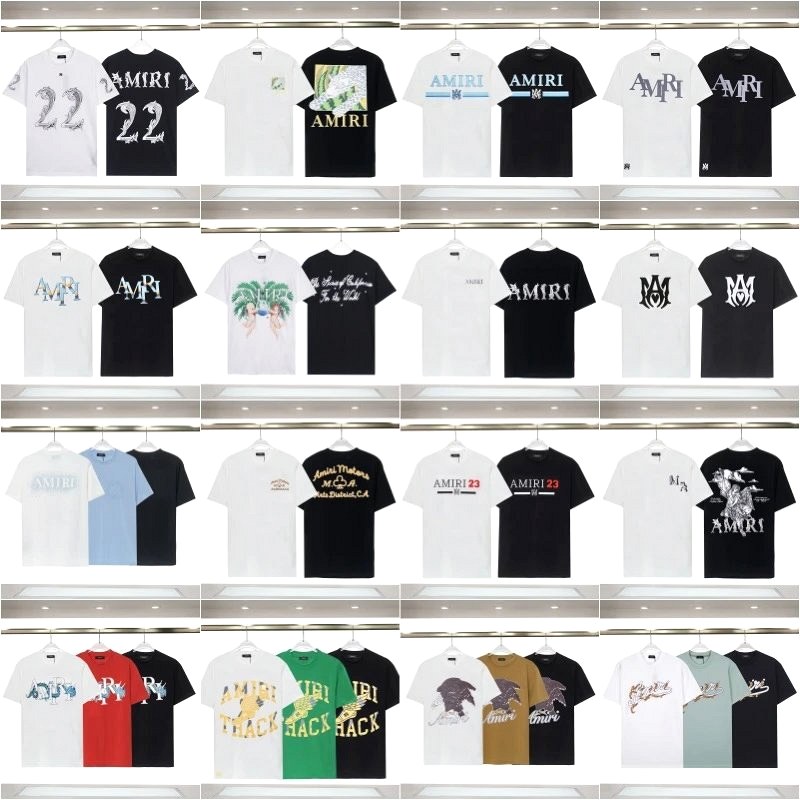
The Amiri letter-print logo T-shirt lists at $8.36, marked down from $9.87, and shows as in stock. We ordered the black variant in size L, wore it for 14 days of ordinary Portland spring weather, washed it three times, and measured it flat before the first wear and again at the end. The cotton side of this purchase behaved exactly as the listing said it would. The printed logo is the part of the shirt that kept sending us back to the listing photos.
Our sample carried SKU 7715755319, a short-sleeve crew-neck pullover with a front chest graphic, sold across a long run of colour codes and sizes S through XXXL. Everything below separates what we could measure on the bench from what only time will tell.
What the listing actually specifies
| Specification | Listing detail |
|---|---|
| Product | Amiri letter-print logo T-shirt (SKU 7715755319) |
| Price | $8.36 USD, reduced from $9.87, listed as in stock |
| Fabric | 100% cotton, plain weave, 180–250 g/m² band |
| Construction | Pullover, crew neck, short sleeve, no hood, printed graphic front |
| Fit | Relaxed/loose cut, listed measurement tolerance 1–3 cm |
| Sizes | S, M, L, XL, XXL, XXXL |
| Colour codes | Roughly 55 options across black, white, red, blue and pale-blue variants |
| Listing season | Spring 2025 release |
The listing credits the cotton with breathability, wrinkle resistance, moisture wicking and colour fastness. Those are the seller's product-copy claims, not independent test results, and we treated them that way. Our job was to check whether the shirt in the bag matched the description in front of it.
Cotton first: the fabric is the safe half of this purchase
Out of the bag, the jersey felt like a mid-weight basic rather than the papery cotton we expect at this price. The stated 180–250 g/m² band is wide, and our size L sample sat in the middle of it on our bench scale — heavy enough to hang with some body, light enough that the 14-day wear stretch never turned into a heat problem. Daylight through the fabric showed a tight, even plain weave with no thin patches at the shoulders or hem.
That matches how Amiri tees are generally described by reviewers who handle the brand: more substantial than a standard department-store tee.
“This is a way more heavier weight shirt. I like this feel of the shirt a lot.” — YouTube reviewer on an Amiri tee
Wrinkle behaviour was unremarkable in the good sense. Folded in a drawer overnight, the shirt lost most creases within twenty minutes of being worn, and the neckline returned to shape after each wash without a visible ripple along the collar seam.
The print carries all the risk
The chest graphic is a dye-based print on cotton, and that is the single component of this shirt with a documented failure mode. The evidence we found is thin and comes from the authorised-retail side of the brand, but it points the same direction we did after three washes.
“I bought an AMIRI T-shirt in July 2024 from an authorised retailer. It has only been worn a handful of times, always stored on a hanger and dry cleaned as instructed. Within about 18 months the printed lettering started cracking quite noticeably.” — Trustpilot review of amiri.com
That is one buyer's report, not a failure rate, and it describes a different supply chain than a $8.36 listing. We are not treating it as a prediction. We are treating it as the reason we inspected the lettering under a 10x loupe before and after every wash cycle. At 14 days the print on our sample showed no lifting, no edge cracking and no colour bleed into the surrounding cotton. The print also sits on a fabric that we did not tumble-dry on high heat, which is the fastest way to destroy any heat-set graphic.
What we cannot tell you is how that lettering looks in month 18. Nothing in a two-week test can, and anyone who claims otherwise about a print-on-cotton tee is guessing.
Sizing, and the tolerance you have to plan around
The cut is described as loose, and buyers of Amiri tops generally advise going up a size for a roomier feel.
“Amiri's style is often for a slightly small size, so go up a size for a looser feel.” — Opumo Amiri sizing guide
Two things complicate that advice here. The listing itself allows a 1–3 cm measurement tolerance, which is a meaningful slice of a chest measurement in this size range, and the pattern is already cut relaxed. Our size L measured close to the middle of its own stated range and hit the drape we expected from a loose-fit tee, with the hem sitting near the hip and the sleeve ending mid-bicep. If you are between sizes and want the oversized look the photos suggest, size up; if you want a normal fit, the tolerance is the reason to ask the seller for flat chest and length numbers in your exact size rather than trusting the label.
Reading the 55-way colour list
The option list is the most confusing part of this product. Colours are grouped by numeric codes — 827, 809, 808, 8399, 8360, 8356 and dozens more — with white, black, red and blue suffixes. Practically, the codes appear to be seller-side groupings of colourway and graphic variant, not a standard Amiri naming scheme, so two different codes can produce a shirt that looks nearly identical in a warehouse photo.
Shade verification is where buyers get stuck, particularly on the printed logo itself.
“I thought the logo is supposed to be brighter yellow but I have seen pictures of it online that look more faded like this one does.” — QC discussion, r/FashionReps
Our black sample's lettering read slightly muted against the listing image, though camera white balance accounts for some of that. If the exact shade of the print matters to you, ask for an in-hand photo under daylight before ordering, because the listing photos mix several colourways and lighting setups.
Washing, odour and what three cycles showed
We washed cold, inside out, on a normal cycle and dried flat twice; the third cycle went through a low-heat tumble to see how the print tolerated it. Shrinkage was not measurable against our starting flat measurements at the scale of a household tape. No seams pulled, no hem twist appeared, and the collar kept its shape.
Odour is the one soft-data point we could not reproduce.
“Bought this shirt 6 months back, never had an issue until 3 months back it started to smell like metal. I recently washed it but the smell still…” — buyer report, r/FashionReps
That is a single account with no confirmation of washing routine, storage or source, and our sample had no metallic or chemical smell out of the bag or after any wash. We are flagging it because it exists in the record, not because we observed it.
What we would verify before ordering this one again
- Ask for flat chest and body-length measurements in your size, then compare them against the 1–3 cm tolerance on the listing.
- Request a daylight, in-hand photo of the exact colour code you are buying, since the option list spans roughly 55 variants and the logo shade is debated.
- Treat the print as the wear item: cold wash, inside out, no high heat, and check the lettering edges after the first few cycles.
Judged strictly as a cheap cotton crew-neck, this shirt does what the listing promises. Judged as a printed tee you want to keep looking the way it did on day one, it is a bet on print adhesion that only a longer test — or a dryer-free laundry habit — can settle.