Two weeks in this AMI Paris heart-print zipper hoodie: how the relaxed fit compares with your usual size, how the 350–400g loopback washes, and what agent fees and shipping add to the $34.03 item price.
- Hands-on score
- 4.0 / 5
Review notes and specifications
The AMI Paris heart-print zipper hoodie collection is a zip-front, drawstring-hood layer in cotton loopback, listed at a $34.03 reference price against a $38.81 original (SKU 7705087738, in stock). It is the kind of item most buyers reach through a shopping agent rather than a brand storefront, which is exactly why the interesting questions are not about the logo. They are about whether the cut matches the size you normally wear, whether 350–400g of terry cloth behaves like the autumn layer the listing promises, and whether the landed cost after agent fees and two shipping legs still makes the item price look like a bargain.
We ordered the collection through an agent and wore the hoodie for two weeks of autumn commuting before washing it three times. Here is what held up, what did not, and what to look at in warehouse photos before your parcel is consolidated.
What we ordered and tested
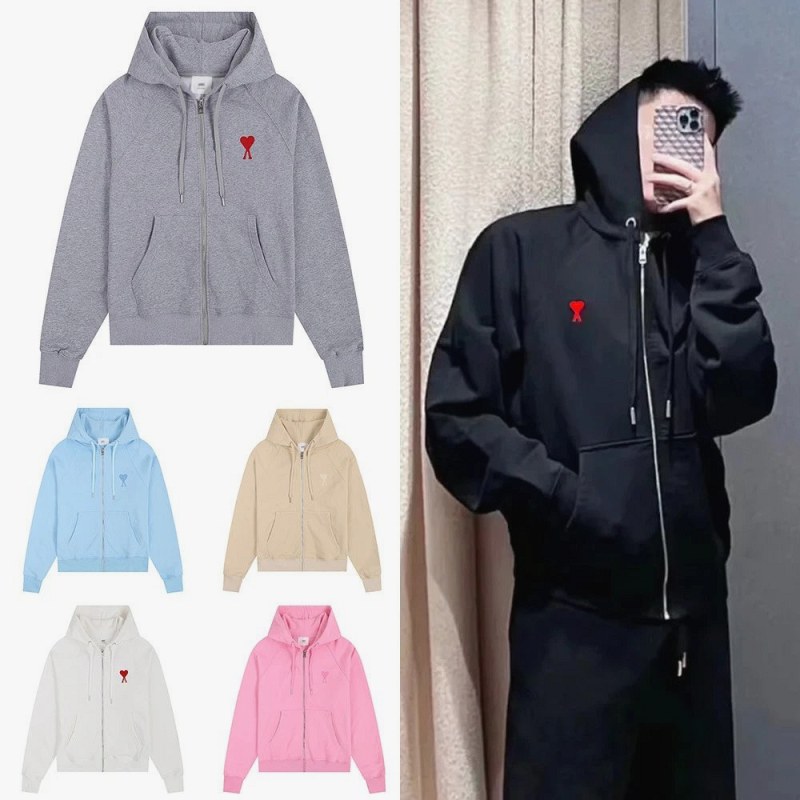
The listing describes a hooded cardigan cut: full-length zipper, drawstring hood, split kangaroo pockets, ribbed cuffs and hem, with a small embroidered heart motif on the chest. Fabric is cotton loopback at a regular thickness, 350–400g, unlined and unbrushed, aimed at autumn. Sizes run S–XL.
| Specification | Listing detail | Our note |
|---|---|---|
| SKU | 7705087738 | Matches the agent listing we ordered from. |
| Price | $34.03 USD (from $38.81), in stock | Item price only; agent and shipping costs sit on top. |
| Fabric | Cotton loopback, 350–400g, no fleece lining | Matches the hand-feel: visible loops inside, no brushed pile. |
| Construction | Zip front, drawstring hood, split kangaroo pockets, ribbed cuffs and hem, embroidered heart at chest | All present on our sample; cuffs and hem are single-layer ribbing. |
| Sizes | S, M, L, XL | Cut wide through the armhole; length scales less than width. |
| Season | Autumn | Accurate. This is a light outer layer, not a winter piece. |
Fit: how it compares with your usual hoodie size
This is the part of the listing that needs the most interpretation. Third-party AMI buying guides consistently advise sizing down on the brand's tops, and the reasoning is structural: the armholes are cut generously, and body length is not shortened proportionally on smaller frames, so moving up a size makes the garment read baggy rather than relaxed. That guidance lines up with published size data for the Ami de Coeur hoodie, which lists roughly 21 in chest and about 25.5 in back length at M.
Our M sample measured just over 21 in across the chest and just under 26 in at the back — close enough to those published figures to use them as your reference point. Measured against a standard mid-weight hoodie in the same size, the body sat wider through the chest and shoulders while the hem stopped at a similar point. The practical result: if you normally wear a M in a fitted hoodie and want this to sit close, an S is the better bet. If you wear your hoodies loose already, staying true to size works, but expect the drop-shoulder line to sit further out than you are used to.
The published AMI figures are for the pullover Ami de Coeur hoodie, not this zip-front cut, so treat them as a directional comparison rather than an exact spec sheet. Measure a hoodie you already like flat across the chest and down the back, and match those two numbers to S–XL.
Fabric and weight: loopback cotton, not fleece
The listing's 350–400g figure describes fabric weight, not a fleece pile, and that distinction matters if you are shopping this as a cold-weather layer. There is no brushed backing and no lining. The inside is loopback terry — visible cotton loops, slightly drier to the touch than a brushed fleece, and noticeably less warm for the same bulk. For autumn and shoulder-season wear under a jacket, that is the right trade: the garment breathes and does not trap heat in the car or on a train.
After three cold washes and hang dries, the changes were modest. The terry softened noticeably by the second wash, mostly in the body and sleeves, and the hood kept its shape. Shrinkage stayed within about a centimetre of body length, which is in line with what unbrushed cotton loopback normally does. The two flaws worth naming: light pilling appeared under the arms and where the cuffs rub on a desk, and the cuff ribbing relaxed slightly, so the sleeve openings no longer grip as firmly as they did out of the bag. Both are cosmetic rather than structural — no seams opened, and the zipper tape did not ripple after washing.
The details worth inspecting
The chest heart emblem
The embroidered heart is the piece's whole visual argument, and it is also the detail most likely to vary between the photo you ordered from and the garment in your hands. Authentication guides for AMI's heart-logo pieces point specifically at the logo's font weight and placement, neck-tag stitching spacing and alignment, and wash-tag font consistency, because replicas typically get those wrong. On our sample, the emblem sat level with the placket, stitches were dense and even, and the felt edges were clean. Check the emblem's position relative to the shoulder seam and the zipper tape: a heart that rides high or sits noticeably off-centre is the first thing you will notice when wearing it open.
The zipper hardware
The listing gives no hardware brand, so the zipper is the component with the least published information and the most mechanical wear. We cycled our sample's zipper several dozen times over two weeks. It ran smoothly, engaged cleanly at the bottom stop, and did not catch on the tape, though the pull is light and unmarked relative to what premium hardware feels like. Ask yourself two things in the QC photos: does the pull look symmetrical and properly finished, and does the slider close flush with the tape rather than leaving a gap at the top. Worn or mismatched hardware is hard to spot in a vendor shot and easy to see in a close-up.
Colorways and how they photograph
The listing carries a long color run organised by numeric suffixes (401, 403, 404, 405, 406, 407). The suffixes appear to group colourway families rather than fit variants, and the 404 group includes two-tone names such as black-red and white-black, which suggests contrasting bodies and emblems. Vendor names are brief, so match the image group for the exact option you pick rather than trusting the label alone.
| Series | Colors listed | How it reads on screen |
|---|---|---|
| 401 | Black, white, grey, navy, light blue, beige, pink | Flat solid tones; the light blue and pink skew brighter than they do in person. |
| 403 | Black, grey, white, khaki, dark green, royal blue, light blue, beige, navy | Broadest everyday palette; khaki and dark green photograph closest to reality. |
| 404 | Navy, black-black, black-red, white-black, white-red, grey, dark green, beige, khaki | Contains the contrasting two-tone options; check which panel carries which colour. |
| 405 | Pink, light blue, light yellow, white, black, light beige, khaki, grey, green | Pastel-leaning set; white and light yellow wash out against white backdrops. |
| 406 | White, heather grey, black, carbon grey, navy, dark red, brown | Melange and deeper tones; heather grey and carbon grey show texture in photos. |
| 407 | Black, navy, army green, light purple | Small, darker run; light purple is the outlier and reads grey-ish on some screens. |
One pattern across the whole run: solid black, navy and carbon grey photograph most accurately, while white, light blue and light yellow are the most likely to disappoint because studio lighting flattens them into a brighter, cleaner tone. If you are choosing between a pastel and a mid-tone and you have not seen a buyer photo, the mid-tone is the safer call. Note also that the collection is broad enough that availability per colour can shift; confirm your option is in stock at checkout rather than assuming the full run is live.
What agent fees, domestic shipping and international shipping add
A $34.03 item price is a starting point, not what you pay. Here is how the number grows in practice:
- Agent service fee. Usually a percentage of the item price or a small flat per-order charge. On a single hoodie this is a modest add-on, but it is the first line that makes the item price irrelevant as an authenticity signal — orders here route through agents, so a low reference price tells you nothing about whether the seller is authorised.
- Domestic shipping inside China. Normally small, sometimes free, and only noticeable when you are consolidating several items.
- International shipping. Charged by weight, in tiers that usually start at the first 0.5 kg or 1 kg. Our hoodie, bagged and boxed for consolidation, landed near the 1 kg mark, so it sits right at a tier boundary on most lines. A heavier knit or a second item in the same parcel can push you into the next tier and change the total more than the agent fee does.
- Consolidation, repacking and any extras. Small, avoidable charges that add up if you request special packaging or split shipments.
The honest way to judge value is to add all four to the item price before you compare it with anything else. Depending on the shipping line you choose and how much you consolidate, a hoodie at this item price typically lands somewhere well above the sticker number — do that arithmetic first, then decide whether the fabric weight and colour run still justify it. If they do at the landed cost, the item price is a genuine saving. If they only worked at $34.03, they did not work.
Warehouse QC photos are the last cheap checkpoint in the whole process. Request them before consolidation, not after the parcel has shipped, because neither the emblem nor the hardware is easy to dispute once the package is in transit.
Warehouse QC before you consolidate
Ask your agent for close-up photos of four things while the item is still in the warehouse:
- The chest emblem, straight on. Confirm placement relative to the placket, the shoulder seam and the pocket line, and that the stitching is even rather than puckered.
- The zipper pull and slider. Check that the pull is symmetrical and finished, and that the slider closes flush to the tape at the top when zipped.
- Both tags. Neck-tag stitching alignment and wash-tag font consistency are the two tag checks authentication guides recommend most often.
- The colourway code on the packaging. Confirm it matches the option you paid for, and for any two-tone option from the 404 group, confirm which panel carries which colour.
If the photos show the emblem off-centre or the hardware mismatched, dispute it while the parcel is still sitting in the warehouse. That is a far simpler fix than a return across two shipping legs.
What we could not confirm
We tested the garment, not the supply chain. There is no independent buyer evidence for this specific listing, which means our read rests on our own two weeks with the hoodie plus brand-level reporting — buyers of AMI Paris garments are generally described as happy with how the pieces fit, feel and look, with neat seams and quality cotton, though those reports cover the brand rather than this listing. One caution worth repeating: a third-party site trading on the amiparis-store name carries a 2/5 customer-review score across 16 reviews, so verify that the seller you are actually ordering from is authorised rather than a look-alike reseller. Do that before you pay, and do the QC photo check before you consolidate.